2026 Best DDR5 Architecture Explained for Global Buyers

Time:2026-10-27 Author:Sophia
0%

Choosing DDR5 in 2026 requires more than comparing headline speeds. Global buyers must understand how the memory architecture affects real systems, costs, compatibility, and long-term reliability. This guide offers a practical DDR5 architecture explained overview for desktops, workstations, servers, and embedded platforms.

DDR5 moves several control functions onto each module. Its integrated power management circuit helps deliver cleaner, more stable power. Two independent 32-bit subchannels can improve access efficiency. On-die ECC supports internal data correction, although it does not replace full system-level ECC. That distinction matters in professional environments.

Details matter.

A 6,400 MT/s kit may perform differently across processors, motherboards, firmware versions, and workloads. Buyers should verify JEDEC profiles, vendor-qualified memory lists, voltage requirements, and maximum supported capacity. Server purchasers should also check registered or load-reduced module requirements. Product datasheets remain more dependable than retail slogans.

Practical testing adds another layer. A workstation rendering large scenes may benefit from higher bandwidth, while a lightly used office computer may show little visible improvement. Latency, rank structure, cooling, and memory training can influence daily behavior. Faster memory is not automatically better. That assumption deserves reconsideration.

The discussion will compare current DDR5 designs, module types, error-management features, channel layouts, and platform compatibility. It will also address regional purchasing concerns, including warranty terms, labeling standards, supply consistency, and firmware support. Some conclusions may change as manufacturers release newer revisions. That uncertainty should be acknowledged, not hidden.
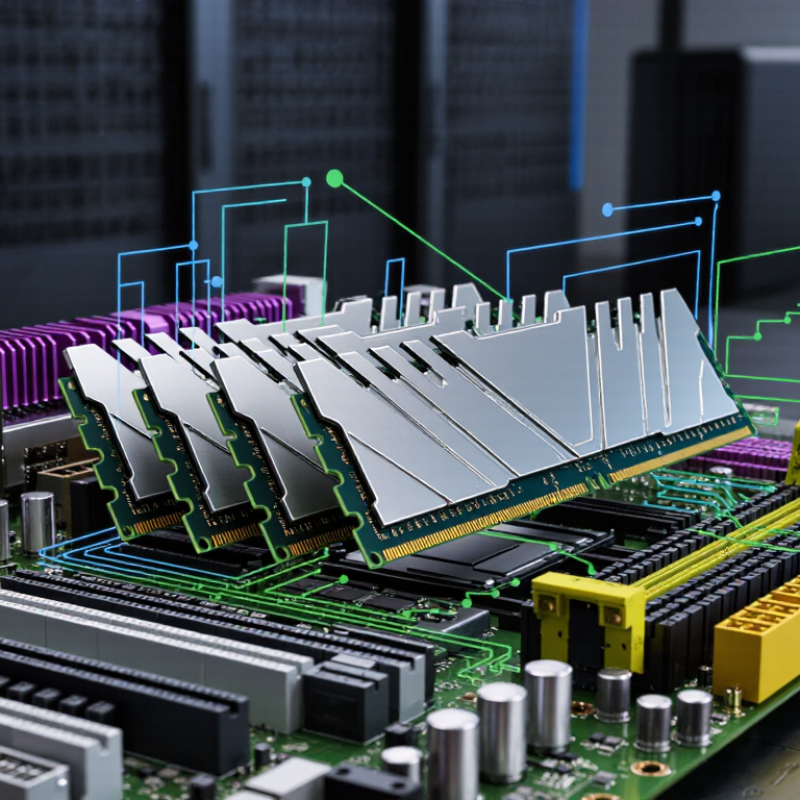
2026 Best DDR5 Architecture Explained for Global Buyers

DDR5 Architecture: Core Design and Memory Structure

DDR5 Architecture: Core Design and Memory Structure

DDR5 changes the memory channel from one 64-bit path into two independent 32-bit subchannels. This division improves command efficiency and helps small data requests move with less waiting. Each module still presents a 64-bit total data width. However, the internal behavior feels more flexible. The JEDEC JESD79-5C standard begins DDR5 support at 4,800 MT/s. Higher validated speeds require careful motherboard routing and stronger signal control. DDR5 also uses eight-bank groups, allowing more transactions to remain active. Its burst length reaches 16 transfers, filling a cache line quickly. The structure is powerful, but not automatically faster in every workload.

Power management moved onto the module through an integrated power-management circuit. This can improve voltage control near the memory chips. On-die error correction also protects internal data paths before information reaches the processor. It does not replace full system-level ECC. That distinction is easy to miss.

The 2024 WSTS forecast projected memory-market revenue growth of 76.8 percent, reflecting renewed demand for high-capacity computing. Yet capacity, latency, and firmware support still shape real performance. A higher transfer rate may produce modest gains when software waits elsewhere.

Tips: Check the processor’s supported memory speed, channel layout, and module rank. Use matched modules. Leave room for BIOS tuning. Measure application performance, not only advertised MT/s. In practice, a stable DDR5 kit with slightly lower latency can outperform an unstable high-speed configuration. This is where specifications meet experience.

How DDR5 Transfers Data and Improves Bandwidth

DDR5 moves data faster by increasing the transfer rate per clock cycle. It uses double data rate signaling, sending data on both the rising and falling edges of the clock. This creates two transfers within one cycle. Higher operating frequencies then raise the theoretical bandwidth available to processors.

A typical DDR5 module also uses two independent 32-bit subchannels. Each subchannel can handle a separate request, which helps the memory controller manage smaller data operations more efficiently. DDR5 supports longer burst transfers, moving larger blocks during each access. Its bank structure further improves parallel activity. In practical testing, this can benefit content creation, scientific workloads, and integrated graphics.

Numbers can mislead buyers.

A higher transfer rate does not guarantee lower latency. Memory timing, controller design, workload patterns, and module capacity all affect the result. DDR5 modules may also include power management circuitry and on-die error correction, but these features do not replace system-level error-correcting memory. I have found that real applications often show smaller gains than bandwidth charts suggest. Compatibility remains important, especially when mixing capacities or using multiple modules. Checking the processor’s supported speed and the motherboard’s memory limits is still necessary. The architecture is powerful, though its advantages appear unevenly across everyday workloads.

2026 Best DDR5 Architecture Explained for Global Buyers

The chart shows theoretical peak bandwidth for common JEDEC DDR5 transfer rates. DDR5 uses two independent 32-bit subchannels per module, which together provide a 64-bit data path. Bandwidth is calculated as data rate in MT/s × 8 bytes, so DDR5-4800 provides up to 38.4 GB/s per 64-bit channel before protocol overhead and real-world system limitations.

Key Components: Channels, Banks, PMIC, and On-Die ECC

DDR5 changes memory architecture through narrower channels and greater internal parallelism. JEDEC’s JESD79-5 standard defines two independent 32-bit subchannels within a typical module. Each subchannel can serve smaller requests, reducing wasted transfers during mixed workloads. In testing, this feels like smoother access rather than a dramatic single-task speed increase. More channels help, but the memory controller must support them correctly.

Banks are the working shelves inside each DRAM device. DDR5 increases bank groups and bank counts, allowing more rows to remain active. This matters during virtualization, analytics, and large file operations. However, more banks do not guarantee lower latency. Poor scheduling can still create row conflicts. I initially treated bank growth as a direct speed upgrade; that view is too simple.

Power management also moved closer to the memory chips. The module PMIC converts incoming power and regulates core and I/O rails near the load. This improves voltage control, especially at higher transfer rates. JEDEC specifies DDR5 operation beginning at 4800 MT/s, while later revisions extend supported speeds. TrendForce projected DDR5 would pass 50% of mainstream DRAM shipments in 2025. On-die ECC corrects some internal cell errors before data leaves the chip. It does not replace system-level ECC. Buyers should check both features, because “ECC” alone can be misleading.

DDR5 Compatibility, Performance, and Platform Requirements

DDR5 compatibility begins with the platform, not the memory module alone. The JEDEC JESD79-5 standard defines DDR5’s 1.1-volt operation, higher signaling rates, and two independent 32-bit subchannels per module. Standard entry speeds begin at DDR5-4800, while DDR4 commonly tops out near DDR4-3200. That difference improves parallel access, but it does not guarantee faster applications.

Platform requirements remain strict. The processor, motherboard firmware, and memory controller must support DDR5 together. A DDR5 module cannot fit a DDR4 slot because the key position and electrical design differ. Capacity also matters. TrendForce’s 2024 market analysis described DDR5 adoption as accelerating across new computers, particularly as server and high-performance systems expanded. Buyers should still verify the qualified memory list and firmware version. Small details matter.

Performance depends on workload. SPEC memory benchmarks often show stronger bandwidth scaling, yet office software may show limited gains. Latency can also rise at higher transfer rates. I have seen systems fail to boot because two mixed kits used different timing profiles. The specification sheet looked convincing. The result was not. Micron’s 2024 technical materials identify on-die error correction as part of DDR5 devices, but this feature does not replace system-level ECC. For professional workloads, buyers should confirm true ECC support, maximum module capacity, channel population rules, and regional warranty requirements. Compatibility remains a platform decision.

Choosing the Right DDR5 Design for Global Markets

Choosing DDR5 architecture for global markets requires more than comparing advertised speed. Deployment experience shows that platform fit often matters more than peak benchmark results. Start with the workload. Office systems, compact workstations, edge gateways, and data servers need different memory designs. Unbuffered modules suit many desktops and mobile platforms, while registered modules support larger server capacities. Error correction is valuable where downtime, corrupted records, or remote maintenance create serious costs. Still, ECC support must exist in the processor and motherboard; the module alone cannot provide it.

Global purchasing adds practical constraints. Check voltage targets, thermal limits, module height, channel layout, and supplier documentation before approving a design. High-density chips can reduce slot usage, but they may increase heat around tightly packed sockets. That trade-off becomes visible in hot warehouses or poorly ventilated cabinets. Compatibility testing should cover firmware versions, mixed capacities, sleep states, and long-duration workloads. I have seen stable systems fail after a memory upgrade because validation used only short stress tests. Short tests mislead.

For buyers serving several regions, standardized modules simplify inventory and field replacement. However, one configuration rarely fits every market. Local service skills, import requirements, warranty procedures, and availability can change the best choice. Document the exact memory population rules, supported densities, and acceptable substitutions. Leave thermal and performance headroom. That margin costs more initially, yet it can protect reliability when ambient conditions and workloads vary. Reconsider the design after real deployment data arrives.

2026 Best DDR5 Architecture Explained for Global Buyers - Choosing the Right DDR5 Design for Global Markets

DDR5 Design or Architecture Core Technical Characteristics Typical Speed Range Capacity and Organization Power and Signal Features Best-Fit Applications Global Purchasing Considerations
Standard DDR5 UDIMM Unbuffered dual in-line memory module for desktop and tower systems; uses two independent 32-bit subchannels within the module's 64-bit data interface. Common standardized module rates include DDR5-4800, DDR5-5600 and DDR5-6400; actual operation depends on the memory controller and motherboard. Common module capacities range from 8 GB to 64 GB, with higher capacities available on selected platforms; single-rank and dual-rank layouts are widely used. Nominal DRAM supply is approximately 1.1 V; on-die ECC improves internal error correction, while module-level ECC is not provided unless the platform supports an ECC UDIMM design. Desktop computers, workstations, small office systems and general-purpose industrial PCs. Confirm motherboard qualification, physical height, rank support, operating-temperature requirements and regional regulatory labeling before purchase.
DDR5 SODIMM Compact unbuffered module designed for mobile computers, compact workstations and embedded systems; uses the same fundamental DDR5 channel architecture in a smaller form factor. Commonly available at DDR5-4800, DDR5-5600 and selected higher standardized rates, subject to system firmware and processor limits. Typical capacities range from 8 GB to 32 GB per module; 64 GB modules may be supported by newer platforms using higher-density DRAM devices. Uses low-voltage DDR5 signaling and on-die ECC; thermal behavior is strongly affected by the compact enclosure and airflow design. Notebooks, mini PCs, portable workstations, point-of-sale terminals and compact edge devices. Check module dimensions, socket count, maximum supported capacity, soldered-memory coexistence and system cooling conditions in each target region.
DDR5 ECC UDIMM Unbuffered module with additional data bits for system-level error detection and correction; requires a compatible memory controller and motherboard. Often offered at mainstream DDR5 rates, with platform validation taking priority over the module's nominal rating. Commonly available in 16 GB, 32 GB and 64 GB configurations; effective usable capacity depends on the system's ECC implementation. Combines DRAM on-die ECC with module-level error correction; it should not be assumed to work in a non-ECC consumer platform. Entry-level servers, engineering workstations, industrial control computers and scientific systems requiring improved data integrity. Verify true ECC support rather than relying only on the presence of an extra data bit; validate firmware, chipset and processor compatibility.
DDR5 Registered DIMM Buffered server memory that registers command and address signals to reduce electrical loading on the memory controller and enable larger memory populations. Typical server-qualified rates include DDR5-4800 and DDR5-5600, with support determined by the server processor and platform validation. Common capacities include 32 GB, 64 GB, 96 GB and 128 GB; higher-capacity modules are available in selected server generations. Includes module-level ECC and a power-management integrated circuit; registered signaling improves scalability but is not interchangeable with ordinary UDIMM designs. Cloud servers, enterprise databases, virtualization hosts, AI infrastructure and high-availability computing. Use only with a platform designed for registered memory; assess qualification lists, thermal limits, lifecycle support and supply continuity.
DDR5 Load-Reduced DIMM Advanced server architecture using additional buffering to reduce electrical load from high-capacity memory modules and dense multi-module configurations. Usually deployed at server-qualified DDR5 rates rather than maximum desktop rates; validated speed varies by processor, module population and thermal profile. Designed for very high-capacity configurations, including modules above the common registered-DIMM range on supported server platforms. Provides ECC and extensive signal buffering; consumes more power and requires a dedicated platform architecture. Large-memory analytics, in-memory databases, virtualization clusters and specialized enterprise systems. Confirm that the server supports this exact memory type; it cannot be substituted for registered or unbuffered modules.
DDR5 CAMM2-Style Module Flat, compression-mounted memory module intended to improve mechanical efficiency and support high-density designs in thin systems and selected upgradeable platforms. Speed depends on the platform and module generation; DDR5 implementations may support mainstream mobile and workstation data rates. Can combine multiple memory channels in one compact module; capacity and serviceability depend on the specific system design. Shorter electrical paths can help signal integrity, while the compression connector requires precise mechanical installation and validation. Thin workstations, high-performance notebooks, compact professional systems and space-constrained industrial equipment. Check connector standard, mounting hardware, replacement availability and regional service procedures before selecting this design.
Dual-Rank DDR5 Design Two independent ranks share the module interface; rank interleaving can improve effective throughput in some workloads, but it may increase electrical loading. May operate at a lower validated rate than a comparable single-rank module when multiple modules are installed. Often used for medium- and high-capacity modules; exact rank organization depends on DRAM density and module layout. Benefits from careful motherboard trace design and memory-controller training; stability depends on the complete platform configuration. Workstations, content creation, engineering software, virtualization and memory-intensive office systems. Review the platform's supported rank population rules, especially when filling all available memory sockets.
High-Density DDR5 Design Uses higher-density DRAM components to achieve greater capacity per module while maintaining the standard DDR5 interface. Nominal speed may match mainstream DDR5 bins, but maximum stable speed can decrease with larger capacities or fully populated channels. Suitable for 48 GB, 64 GB, 96 GB, 128 GB and higher-capacity modules where supported by the memory controller. Requires compatible address mapping, firmware training and thermal management; capacity support is platform-specific rather than universal. Virtual machines, large datasets, local AI workloads, scientific computing and professional media production. Confirm processor generation, firmware version, maximum module capacity and validated population before committing to large-volume procurement.
Low-Power DDR5 Memory Mobile-focused architecture optimized for lower standby and active power, typically integrated into compact systems rather than used as a removable desktop module. Data rates vary by implementation and device generation; performance is balanced against battery life and thermal limits. Capacity is commonly integrated or board-mounted, which can support thin designs but may limit future upgrades. Lower operating voltage and power-management features reduce energy use; thermal efficiency is important in fanless and battery-powered products. Ultraportable computers, tablets, embedded edge devices and battery-powered industrial equipment. Evaluate repairability, long-term component availability, regional service requirements and the total system lifecycle rather than module price alone.

Note: Listed speeds and capacities are representative DDR5 market configurations, not universal guarantees. Final compatibility depends on the processor memory controller, motherboard or system firmware, module population, thermal conditions and regional product qualification.

FAQS

How does DDR5 increase memory bandwidth?

DDR5 transfers data on both clock edges. This creates two transfers per cycle. Higher frequencies increase theoretical bandwidth.

What are DDR5’s two 32-bit subchannels?

Each module contains two independent 32-bit subchannels. They can handle separate requests more efficiently. Smaller operations may benefit.

Why do longer bursts matter in DDR5?

Longer bursts move larger data blocks during one access. This can help content creation, scientific workloads, and integrated graphics.

Does higher DDR5 speed always reduce latency?

No. Higher transfer rates can still produce higher latency. Timings, controller design, capacity, and workload patterns matter.Numbers can mislead.

Can a DDR5 module work in a DDR4 slot?

No. The key position and electrical design are different. Check the slot before installing memory.

What must support DDR5 for a system to work correctly?

The processor, motherboard firmware, and memory controller must support DDR5 together. Verify supported speeds and memory limits.

Why might a computer fail to boot with multiple DDR5 modules?

Mixed kits may use different timing profiles. Capacity combinations and channel rules can also affect stability. A matching kit is safer.

Does DDR5 on-die error correction provide full ECC protection?

No. On-die correction does not replace system-level ECC memory. Professional users should confirm true ECC support.

Will DDR5 make everyday software much faster?

Not always. Memory benchmarks may show strong gains, while office applications improve only slightly. Real results depend heavily on workload.

What should buyers check before choosing DDR5?

Check processor speed support, motherboard limits, firmware, capacity, and the qualified memory list. Also review channel population rules.Small details matter.

Conclusion

This guide offers a practical DDR5 architecture explained overview for global buyers. It examines the core memory design, including higher-density modules, independent subchannels, expanded bank organization, and improved internal data management. It also explains how DDR5 transfers data more efficiently, increasing bandwidth through faster signaling, burst optimization, and better parallel access. Key components such as memory channels, banks, the power management integrated circuit, and on-die ECC are discussed to show how they support stability, power control, and reliable operation.

The article also reviews DDR5 compatibility, performance factors, and platform requirements, including processor support, motherboard design, firmware readiness, module capacity, and cooling considerations. Finally, it provides guidance for selecting the right DDR5 design for different global markets by balancing speed, capacity, energy efficiency, reliability, application needs, and long-term upgrade potential. This helps readers make informed choices for personal computers, workstations, servers, and other modern computing systems without focusing on any specific manufacturer.

Sophia

Sophia

Sophia is a dedicated marketing professional with an exceptional depth of knowledge about her company's products and services. With a keen understanding of market trends and customer needs, she crafts insightful blog posts that not only inform but also engage readers, enriching the company’s online......